
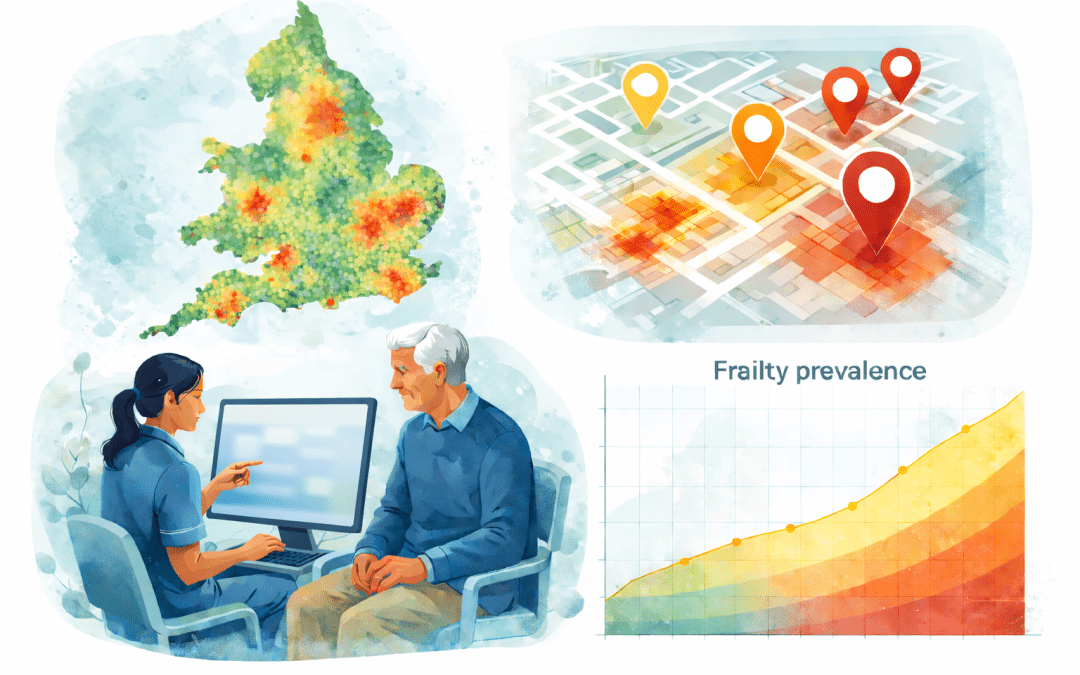
We then framed population health management through four core neighbourhood capabilities: identifying frailty, prioritising those most at risk of deterioration, delivering interventions matched to need, and monitoring outcomes.
This article focuses on the first capability, where we find another paradox: frailty is already being identified across the NHS, but inconsistently applied, insufficiently shared, and not translated into coordinated action.
Why frailty identification matters
Frailty identification is the entry point to population health management. It must be accurate, scalable across the whole population, enable early identification, and be simple for clinicians to use.
But identification alone is not enough. It must lead to action.
The central role of general practice
- Continuity: where present, it provides longitudinal insight, enabling changes in function to be recognised over time.
- Coverage: near-universal registration gives primary care a whole population view.
- Single source of truth: the general practice record brings together most clinical correspondence across the system.
Together, this makes primary care the natural setting to anchor population-level frailty identification and support a shared, system-wide frailty register. This register should not rely on general practice data alone, but draw on inputs from across the system, including community, acute, and social care, whether through shared records or federated datasets.
The policy challenge is clear: how to identify frailty across its full natural lifecourse, from mild to severe, at a whole population level. This requires tools that are systematic, clinically meaningful, and operationally usable.
The most widely used approaches are the Electronic Frailty Index (eFI) and the Clinical Frailty Scale (CFS).
The Electronic Frailty Index: systematic population risk stratification with limitations
The Electronic Frailty Index enables systematic population-level risk stratification using routinely collected primary care data(1). Identified patients are then reviewed by clinicians, who confirm frailty using clinical judgement, typically supported by a notes review(2). However, its limitations follow directly from its design.
The eFI depends on coded data. Long term conditions are generally well recorded, but earlier and more sensitive indicators of frailty, such as functional decline, are often under-coded. In practice, this can be significant: in our practice, eFI identified fewer than half of patients later recognised as living with frailty. While this will vary by setting, it illustrates how reliance on coded data alone can miss clinically evident frailty(3,4).
It also assumes a broadly linear relationship between accumulated deficits and frailty severity, which does not always reflect clinical reality(3,4).
Developments such as eFI2 attempt to improve accuracy by expanding the range of deficits and refining modelling(5). These refinements do not change the underlying approach: eFI does not diagnose frailty. It identifies those at risk who require clinical review, and its “moderate” and “severe” categories are not frailty diagnoses but risk strata that prompt assessment, not confirmed clinical states(2).
Despite these limitations, the eFI remains widely used because it addresses a critical requirement of population health management: identification at scale.
The Clinical Frailty Scale: clinical meaning with limitations
However, studies show variable agreement between clinicians across the full 1 to 9 scale(8,9), raising a more fundamental question: while the scale offers detailed gradation, does this level of precision meaningfully change clinical practice?
In general, care is guided by categories such as:
- 1 to 3 → not frail → prevention and risk reduction
- 4 to 5 → mild frailty → early intervention
- 6 → moderate frailty → protecting and optimising function
- 7 to 8 → severe frailty → comfort, stability, and supportive care
- 9 → terminal illness → palliative care (end-of-life care, not a frailty state)
From a population health management perspective, it is these broader frailty states, rather than the precise numerical score, that shape management. We will return to this when discussing evidence-based interventions later in the series.
There are also practical constraints. The CFS can be misapplied, particularly in people with stable disability(10), and it is not used systematically across populations. It is typically applied during clinical encounters, which limits its role in proactive case-finding.
The underlying challenge
- eFI provides systematic population risk stratification, but imperfect clinical accuracy
- CFS supports clinical diagnosis and decision-making, but is not applied systematically
While these approaches are often used together in practice, they remain only partially integrated and do not yet provide a consistent, system-wide view.
Where this series goes next
References
- Clegg A, Bates C, Young J, et al. Development and validation of an electronic frailty index using routine primary care electronic health record data. Age and Ageing 2016;45(3):353-360. doi: 10.1093/ageing/afw039.
- The Electronic Frailty Index. NHS England, 2019. Available at: https://www.england.nhs.uk/ourwork/clinical-policy/older-people/frailty/efi/
- Mulla, E. et al. Is proactive frailty identification a good idea? A qualitative interview study. British Journal of General Practice 2021; 71 (709): e604-e613. DOI:https://doi.org/10.3399/BJGP.2020.0178
- Broad, A.; Carter, B.; Mckelvie, S.; Hewitt, J. The Convergent Validity of the electronic Frailty Index (eFI) with the Clinical Frailty Scale (CFS). Geriatrics 2020, 5, 88. https://doi.org/10.3390/geriatrics5040088
- Best K, Shuweihdi F, Alvarez JCB, et al. Development and external validation of the electronic frailty index 2 using routine primary care electronic health record data. Age Ageing. 2025;54(4):afaf077. doi: 10.1093/ageing/afaf077
- Rockwood K, Song X, MacKnight C, et al.; A global clinical measure of fitness and frailty in elderly people. Cmaj 2005;173(5):489-95. doi: 10.1503/cmaj.050051.
- Church, S., et al.A scoping review of the Clinical Frailty Scale. BMC Geriatr 20, 393 (2020). https://doi.org/10.1186/s12877-020-01801-7
- Hörlin E, et al. Inter-rater reliability of the Clinical Frailty Scale by staff members in a Swedish emergency department setting. Acad Emerg Med. 2022 Dec;29(12):1431-1437. doi: 10.1111/acem.14603.
- Surkan, M. et al. Interrater reliability of the Clinical Frailty Scale by Geriatrician and Intensivist in Patients Admitted to the Intensive Care Unit. Can Geriatr J . 2020 23(3):223-9. Doi: https://doi.org/10.5770/cgj.23.398
- Halpin, S. More than a Number; the limitations of the Clinical Frailty Scale for patient escalation decision-making in COVID-19. Advances in Clinical Neuroscience and Rehabilitation. April 2020. https://acnr.co.uk/articles/clinical-frailty-scale
- Attwood, D. et al. The Pathfields Tool: a frailty case-finding tool using primary care IT—implications for population health management, Age and Ageing, Volume 49, Issue 6, November 2020, Pages 1087–1092, https://doi.org/10.1093/ageing/afaa119