Digital Infrastructure for Population Health Management of Frailty
Why Shared Digital Infrastructure Matters
Population health management of frailty is one of the most complex challenges facing neighbourhood health systems. Delivery requires systematic frailty identification, risk stratification, and longitudinal Comprehensive Geriatric Assessment (CGA). This requires multiple organisations and professionals to work together through Frailty Hubs and Integrated Neighbourhood Teams.
However, current neighbourhood systems were not designed to support this level of coordination and complexity across multiple providers, teams, and interactions over time.
As a result, three barriers consistently disrupt proactive frailty care at neighbourhood scale:
- Fragmented records where information does not flow: frailty diagnoses, deterioration signals, assessments, and care plans often remain fragmented across organisations rather than functioning as a shared neighbourhood care record.
- Longitudinal CGA creates ongoing time burden: Comprehensive Geriatric Assessment (CGA) is a continuously evolving multidisciplinary process requiring ongoing review, updating, coordination, and communication across neighbourhood teams over time.
- Human error is inevitable: no clinician or isolated team can reliably track every condition, medication, risk, and changing need across a neighbourhood population using fragmented systems alone.
These barriers are explored in greater detail in Part 7 of the NHS Frailty Paradox series, where we examine how fragmented information and human cognitive limits can limit the effectiveness of neighbourhood frailty care.
The following sections explore how shared digital infrastructure can help address these challenges and support population health management for frailty, themes explored further in Part 8 of the Frailty Paradox series.
1. Fragmented Records Where Information Does Not Flow
This fragmentation affects every stage of frailty population health management, including:
- Frailty identification: without shared digital records, frailty identified in one service may remain invisible to the wider neighbourhood team, delaying proactive care.
- Risk stratification and prioritisation: deterioration signals such as falls, high-risk prescribing, hospital attendance, and worsening long-term conditions remain fragmented across organisations, meaning high-risk patients are not prioritised early.
- Comprehensive Geriatric Assessment (CGA): without shared digital records, CGA is repeatedly recreated across teams, causing duplication, incomplete assessment, and loss of continuity.
- Continuity across services: fragmented systems interrupt continuity, forcing patients and carers to repeatedly retell their story while preventing teams building a shared longitudinal understanding of need.
- Multidisciplinary coordination: Integrated Neighbourhood Teams and Frailty Hubs cannot coordinate effectively when shared assessments, care plans, and deterioration are not visible across the system.
- Monitoring and evaluation: fragmented infrastructure prevents neighbourhood systems generating the shared population intelligence needed to monitor outcomes, track frailty trajectories, and improve care at scale.
Digital infrastructure is the cross-cutting foundation that allows population health management of frailty to function at neighbourhood scale.
2. Longitudinal CGA Creates Continuous Time Burden
Without shared digital infrastructure, assessments, care plans, prescribing decisions, and risks must be repeatedly reviewed and communicated across multiple providers.
3. Human Error in CGA is Inevitable
Each domain contains further subdomains, interactions, and competing risks.
No clinician or isolated team can reliably track every interaction, every risk, and every changing need across a neighbourhood population using fragmented systems alone.
In practice, clinicians prioritise what is visible, urgent, or immediately actionable. Known problems are addressed first. Risks that are not visible may remain unidentified, unprioritised, and unmanaged.
This is not failure of effort or expertise. It is human error, the inevitable consequence of human cognitive limits interacting with highly complex systems.
Fragmented digital systems separate information across organisations, making deterioration patterns and emerging risks easier to miss.
Neighbourhood systems increase the risk of human error further by distributing assessment, decision-making, and continuity across multiple organisations and professionals over time.
The goal is to use shared digital infrastructure at neighbourhood scale to augment clinical judgement and deliver better continuity, coordination, and higher-quality CGA.
How Digital Infrastructure Enables Population Health Management of Frailty in Neighbourhoods
Digital infrastructure is therefore the foundation of population health management of frailty, allowing Integrated Neighbourhood Teams and Frailty Hubs to function as a single coordinated system rather than fragmented organisational activity.
The following sections explore how shared digital infrastructure supports each component of population health management of frailty, from frailty identification and risk stratification through to longitudinal CGA, continuity, prescribing safety, and population-level intelligence.
Frailty Identification
This makes frailty visible across the wider neighbourhood team while supporting automated population-level identification and earlier recognition of patients who may otherwise remain unidentified until deterioration or crisis occurs.
Further detail is explored here:
Frailty Risk Stratification and Prioritisation
High-Risk Prescribing Searches
Digital searches combining frailty identification with high-risk prescribing allows neighbourhood teams to identify patients where medication may be contributing to instability, falls risk, delirium, hospital attendance, or functional decline.
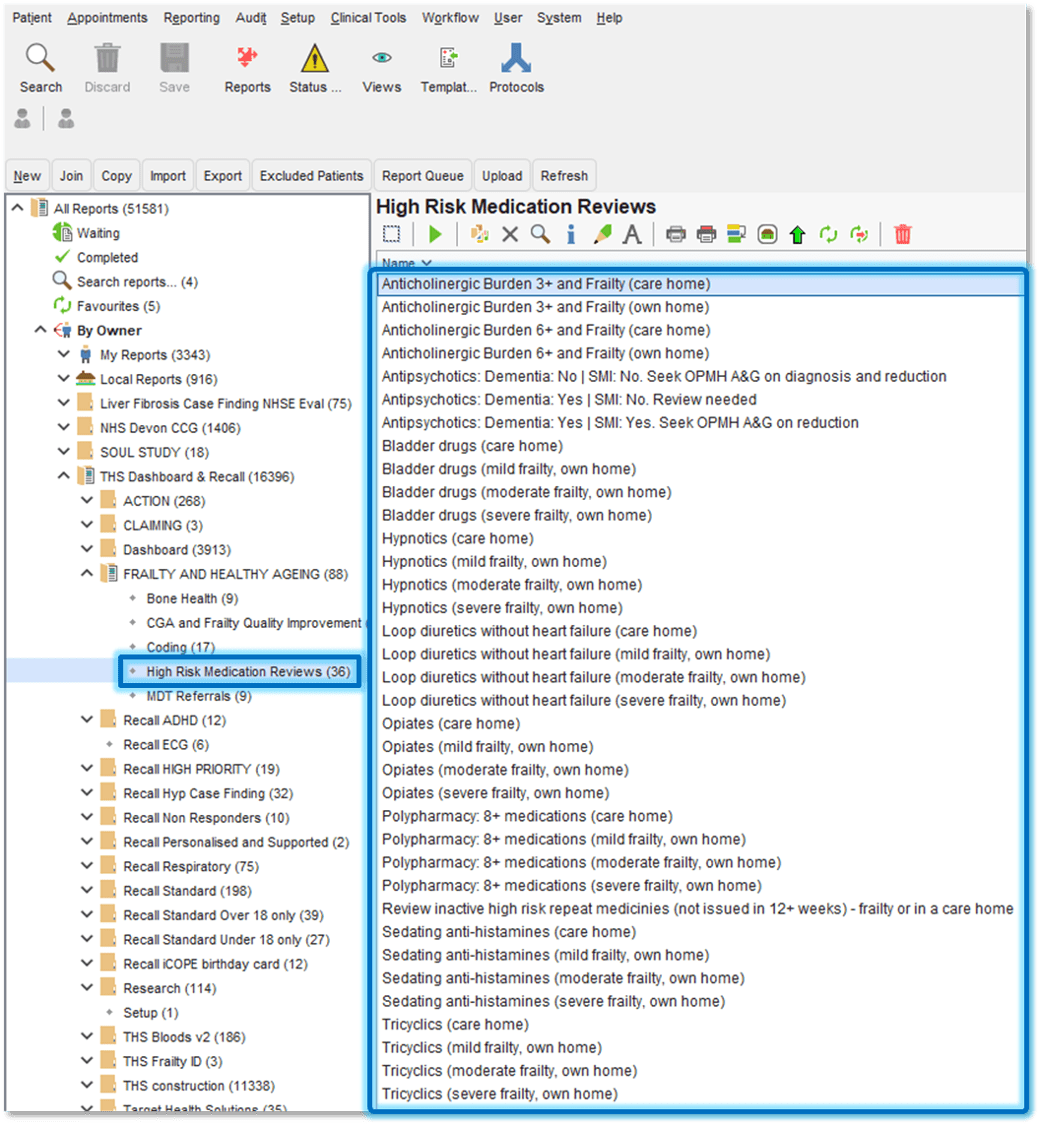
Figure 1: searches combining frailty with high risk prescribing data to identify patients who may benefit from targeted medication review or escalation to MDT
In frailty, high-risk prescribing is often a signal of wider instability and unmet need. For example, a tricyclic antidepressant in a person living with frailty may coexist with other high-risk medication, poorly controlled long-term conditions, worsening mobility, recent Emergency Department attendance, increasing dependency, or social vulnerability.
The prescribing issue is therefore not simply the problem itself. It is often the point at which wider deterioration becomes visible, allowing neighbourhood teams to identify patients who may require proactive multidisciplinary intervention rather than isolated medication review alone.
In some patients, this may trigger targeted pharmacist review. In others, it may trigger escalation to multidisciplinary review to address wider unmet need.
MDT Prioritisation
Falls, fractures, recurrent admissions, worsening frailty, malnutrition, increasing dependency, and rising healthcare utilisation can all be combined within neighbourhood searches to identify and prioritise patients most likely to benefit from proactive MDT input.
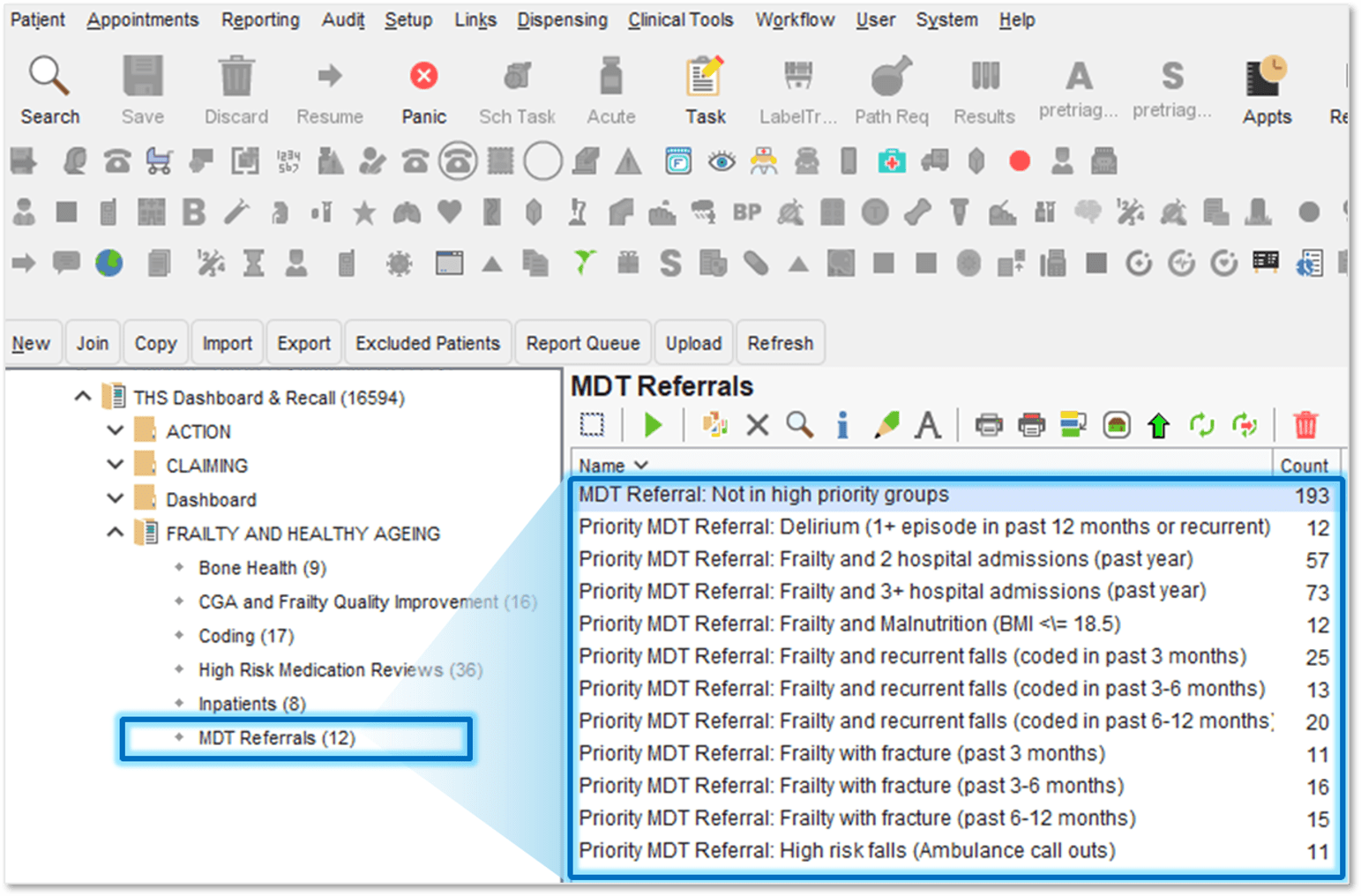
Figure 2: Targeted MDT search combining frailty with high-risk signals such as falls, admissions, malnutrition, and fracture to identify patients requiring coordinated intervention.
iCGA 3.0: An IT-Assisted Comprehensive Geriatric Assessment
1. A Shared Multidisciplinary Assessment
Teams can continuously build the same evolving assessment rather than recreate separate versions across organisations, reducing duplication while improving continuity and longitudinal understanding of patient need.
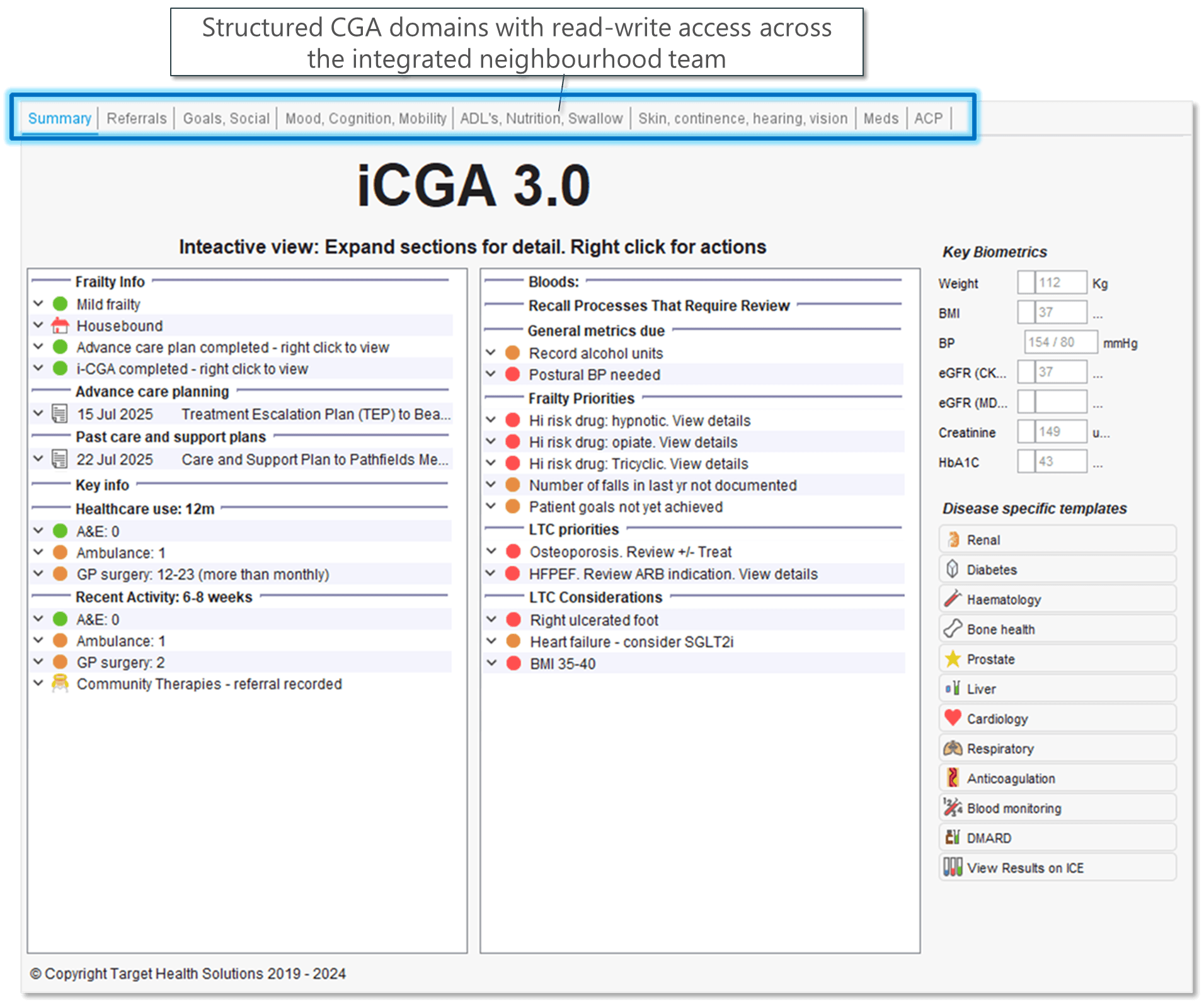
Figure 3: Shared read-write iCGA enables Integrated Neighbourhood Teams to coordinate longitudinal frailty care across organisations.
2. A Consolidated Clinical View
Clinicians can rapidly understand important clinical context without reviewing multiple records, while both known and less visible risks become easier to identify across the neighbourhood record.
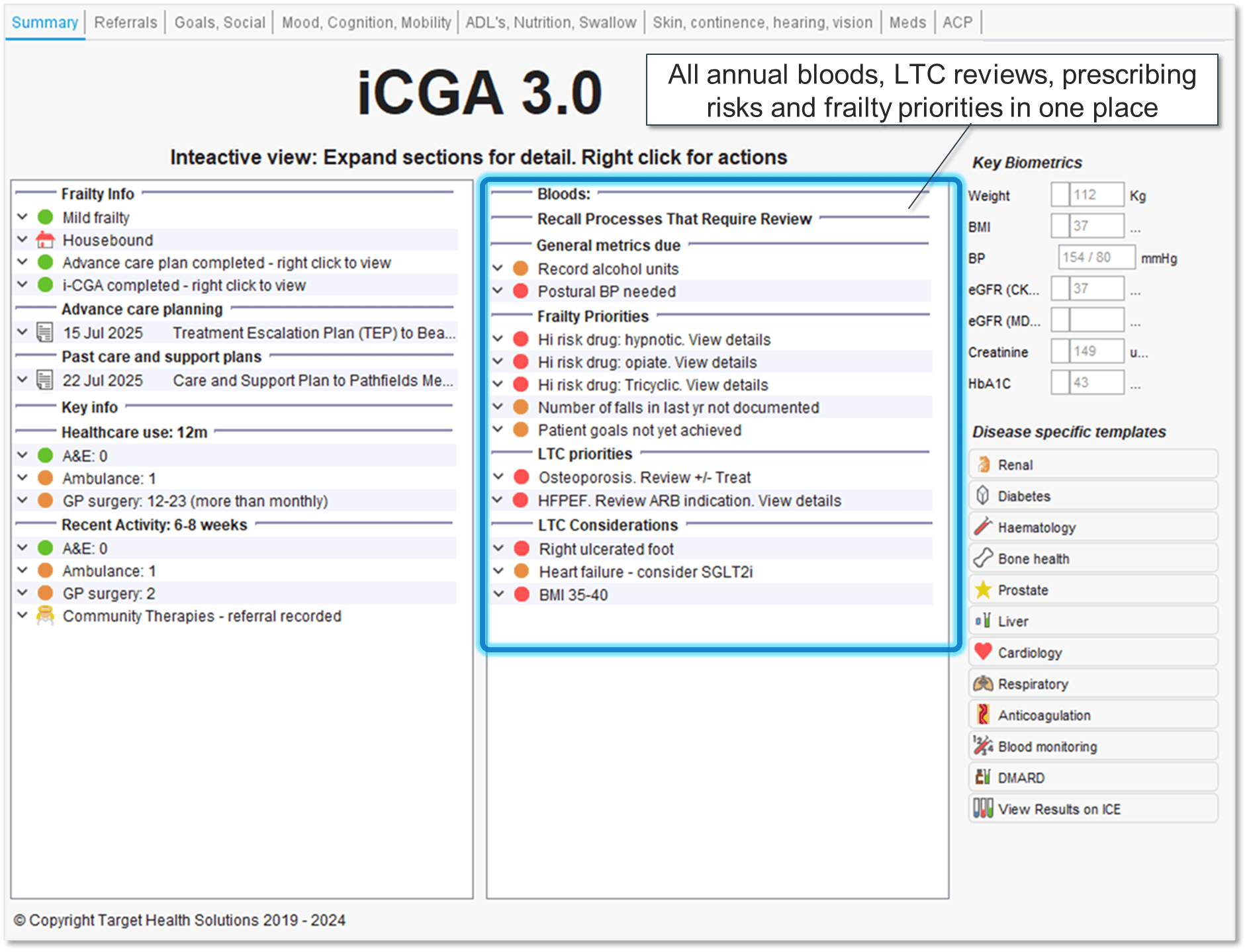
Figure 4: iCGA 3.0 consolidates frailty priorities, prescribing risks, long-term condition reviews, and deterioration signals into a shared longitudinal clinical view for Integrated Neighbourhood Teams.
3. Shared Care Plans Across Providers
Providers across the neighbourhood system can work from the same evolving care plan, reducing repeated information gathering during deterioration or crisis while improving visibility of previous decisions and escalation plans.
4. THS Continuity Alerts
iCGA 3.0 uses THS continuity alerts to rapidly surface important risks, events, and clinical information during patient review.
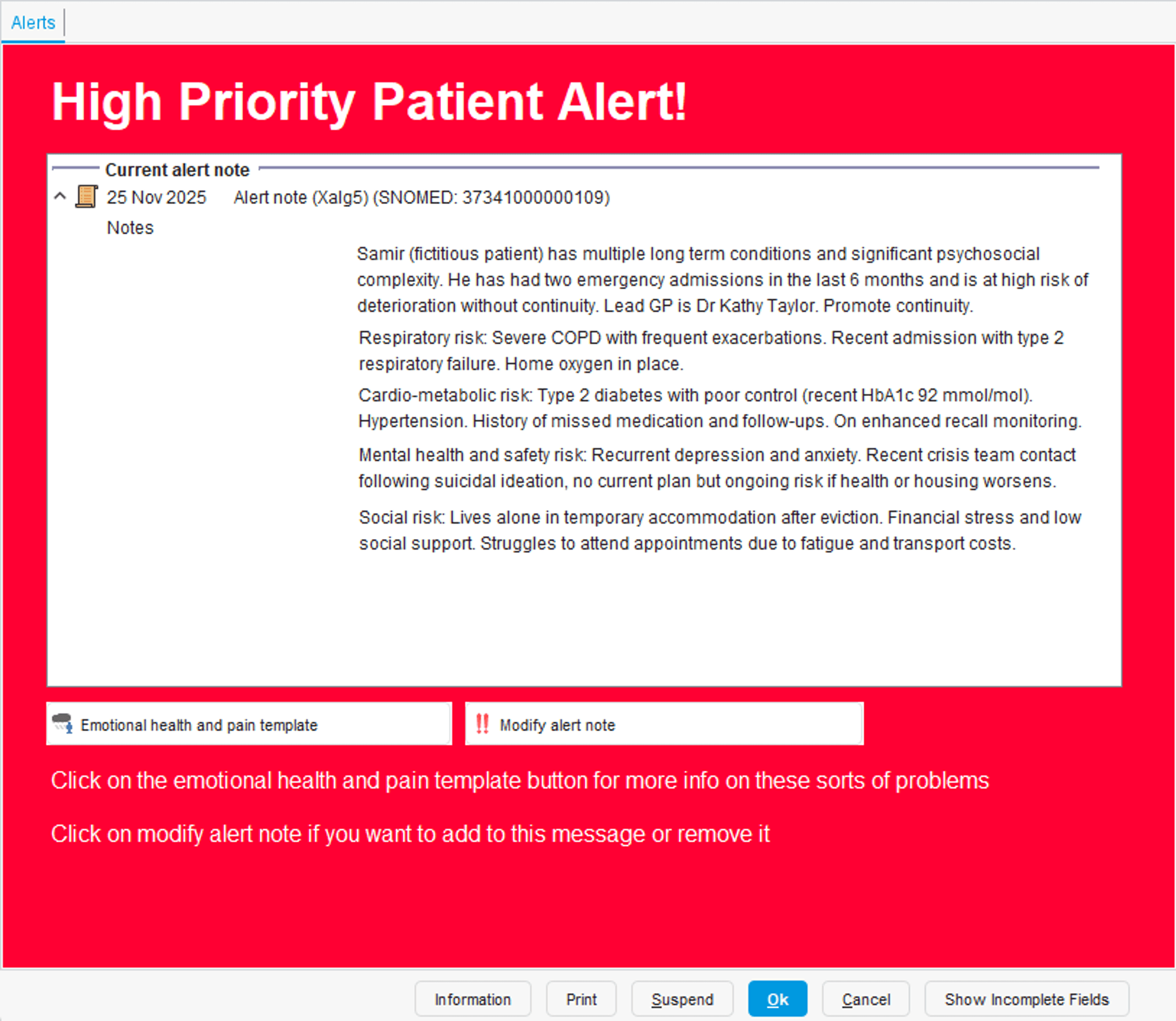
Figure 5: THS continuity alerts rapidly surface important risks, events, and clinical context during patient review, improving continuity and longitudinal frailty care across neighbourhood teams.
5. Integration with Long-Term Condition Management
Poorly controlled long-term conditions frequently contribute to worsening frailty, loss of function, and hospital admission. Conversely, proactive optimisation of long-term conditions may stabilise or improve frailty trajectories over time.
This links frailty management with wider long-term condition care while supporting more systematic recall, monitoring, follow-up, and longitudinal management across neighbourhood systems.
Further detail is explored here:
6. High-Risk Prescribing Alerts
When a clinician attempts to prescribe a high-risk medication, the system automatically generates a warning at the point of prescribing explaining why the medication may be unsafe, the potential consequences, and possible safer alternatives.
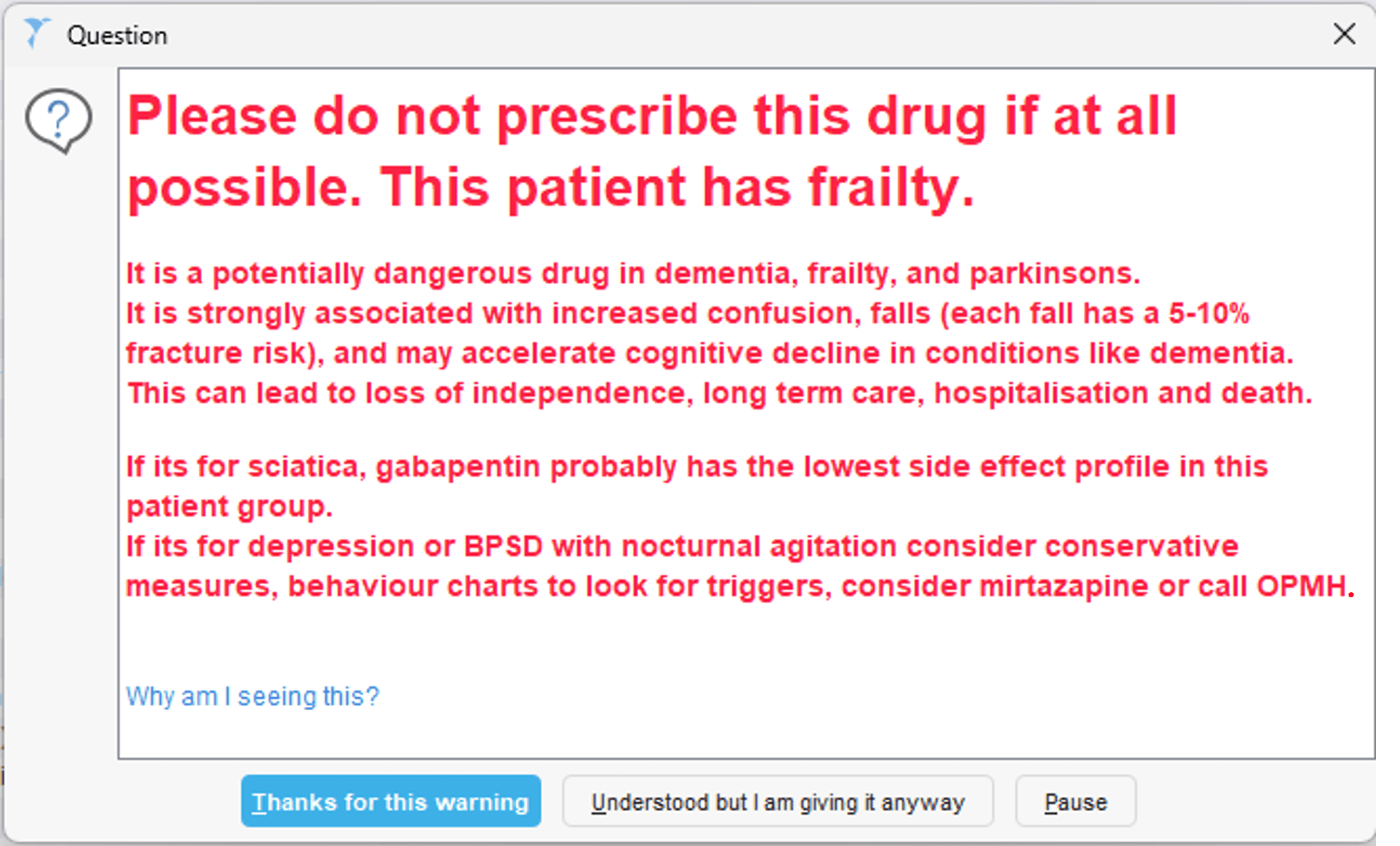
Figure 6: THS prescribing alerts provide point-of-prescribing decision support by by identifying high-risk medications in patients living with frailty (amitriptyline in this example) and suggesting safer alternatives.
7. Delirium case-finding
Improved delirium recognition is important because delirium is associated with worsening frailty, loss of independence, cognitive decline, and poorer hospital outcomes. Earlier identification may support advance care planning and allow neighbourhood teams to consider alternatives to hospital admission, such as Hospital at Home or Virtual Wards, where delirium risk may be lower.
The THS Dashboard: Monitoring and Evaluation
The THS population health dashboard integrates with SystmOne to monitor frailty outcomes across neighbourhood populations, including frailty prevalence, advance care planning, prescribing, and long-term condition management.
This generates shared population-level intelligence to support more informed neighbourhood decision-making while automating monitoring and evaluation.
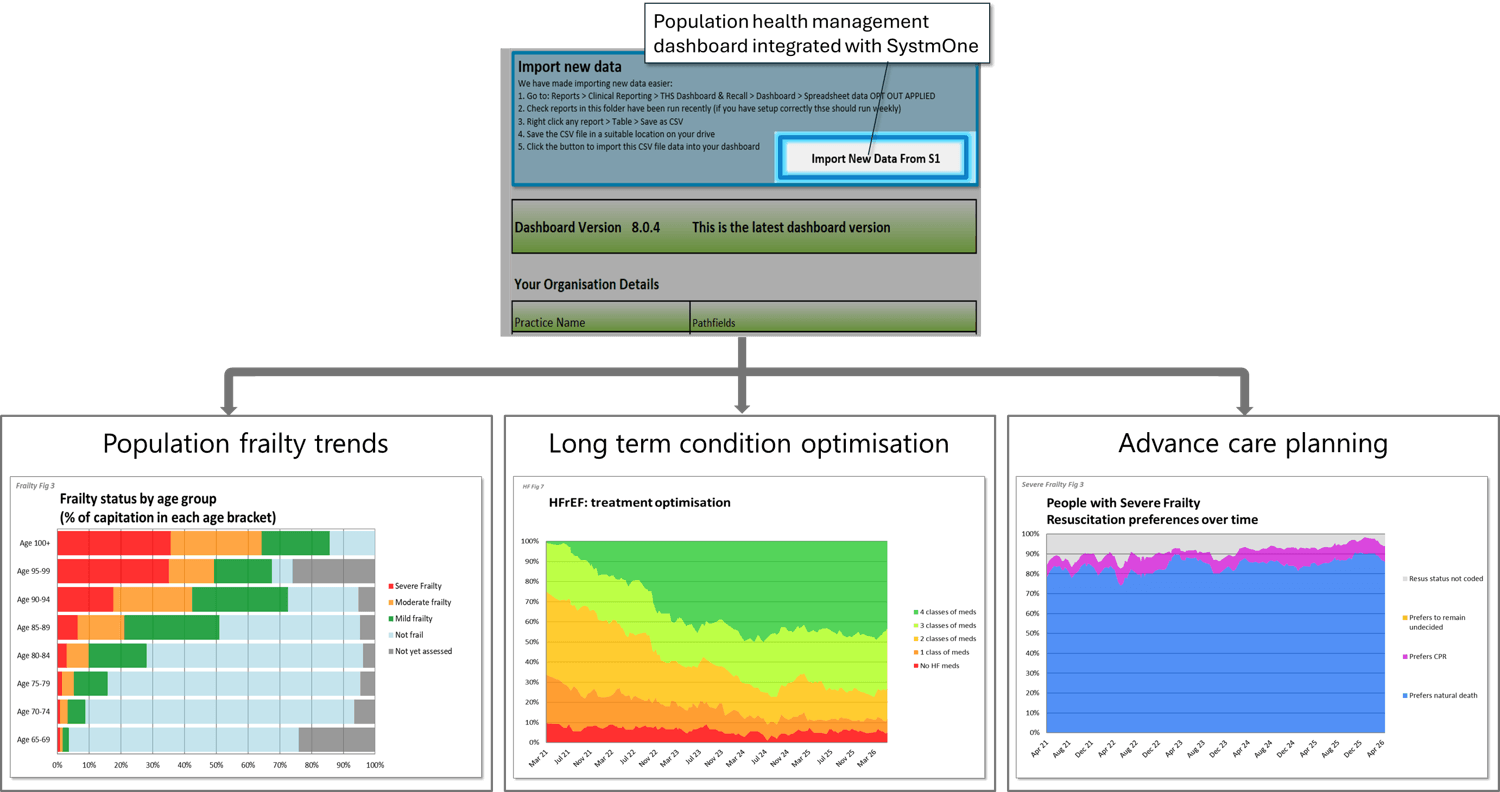
Figure 7: The THS population health dashboard converts structured clinical data into population-level intelligence to support monitoring, prioritisation, and service improvement across neighbourhood populations. Over 250 graphs and outcome metrics are available, with the examples shown here illustrating frailty trends, long-term condition optimisation, and advance care planning.
Provider Challenges and Digital Convergence
However, full digital convergence may not always be feasible because providers operate under different technical, financial, and organisational constraints.
As a result, many systems rely on interoperability layers and shared care records. While these improve read-only access to information, they do not recreate the continuous shared read-write record required for population health management of frailty. Fragmentation and continuity failure therefore persist.
However, systems can still decide where the digital front door of the hospital begins and where the community back door ends for patients living with frailty.
Keeping frailty pathways such as SDEC, outpatient frailty services, UCR, Hospital at Home, and Virtual Wards within a shared neighbourhood digital footprint will improve continuity, longitudinal CGA, and proactive care while reducing avoidable hospital admission.
Digital Infrastructure for Neighbourhood Frailty Care: Summary
Without shared digital infrastructure, information fragments, continuity becomes difficult to sustain, and the complexity of frailty care increases the risk of human error.
Shared read-write neighbourhood records allow frailty identification, risk stratification, iCGA, prescribing safety, multidisciplinary coordination, and population health management to function within the same operational environment.
Tools such as the Pathfields Tool, iCGA 3.0, continuity alerts, prescribing support, and delirium case-finding demonstrate how digitally enabled neighbourhood systems can reduce fragmentation, support clinical decision-making, and deliver more proactive frailty care at neighbourhood scale.
Contact us