Yet the NHS still delivers this care in fragments. CGAs remain isolated assessments rather than functioning as a continuous process. Continuity and coordination are lost through repeated referrals and handovers between teams, rather than services organising themselves around the individual and their loved ones.
We do not need more services. We need to better connect what already exists into a coordinated model that allows CGA to function as intended. This article explores what that looks like in practice.
Continuity requires permanence
And that is the problem.
Most NHS services are designed around defined periods of involvement. People are referred in, treated, and discharged. Clinical responsibility moves between teams as needs change.
But effective CGA depends on several forms of continuity working together.
- Relational continuity, where responsibility and relationships continue over time, allowing trust, familiarity, and understanding to develop gradually rather than restarting at each interaction
- Informational continuity, where shared records, decisions, and personal knowledge follow the individual across organisational boundaries so care does not fragment between systems and teams
Within the NHS, there is one part of the system that consistently operates in this way. It provides near-universal registration, a longitudinal record that integrates information across healthcare interactions, and ongoing involvement before deterioration, during crisis, and after recovery.
It is also a natural anchor point for frailty identification and prioritisation, helping bring together signals of deterioration from across the system so worsening frailty becomes visible earlier across neighbourhood populations.
It’s General Practice.
Coordinated frailty care requires neighbourhood infrastructure
Whilst General Practice can provide continuity, this alone is not enough. It cannot coordinate complex frailty care in isolation.
Delivering effective CGA for people living with frailty requires multidisciplinary coordination across neighbourhood teams, organisations, and sectors.
In practice, this means:
• A single point of contact
• Coordination across the full frailty journey, including prevention, proactive care, and urgent care
• Multidisciplinary teams organised around local populations
To combine continuity with coordinated multidisciplinary care, General Practice needs a structure that allows continuity to extend beyond individual practice boundaries into a neighbourhood-wide model working across multiple providers and services.
Importantly, much of this infrastructure already exists.
Every General Practice is part of a Primary Care Network (PCN). PCNs provide the natural neighbourhood footprint for coordinating frailty care around a registered population while keeping continuity anchored close to the individual.
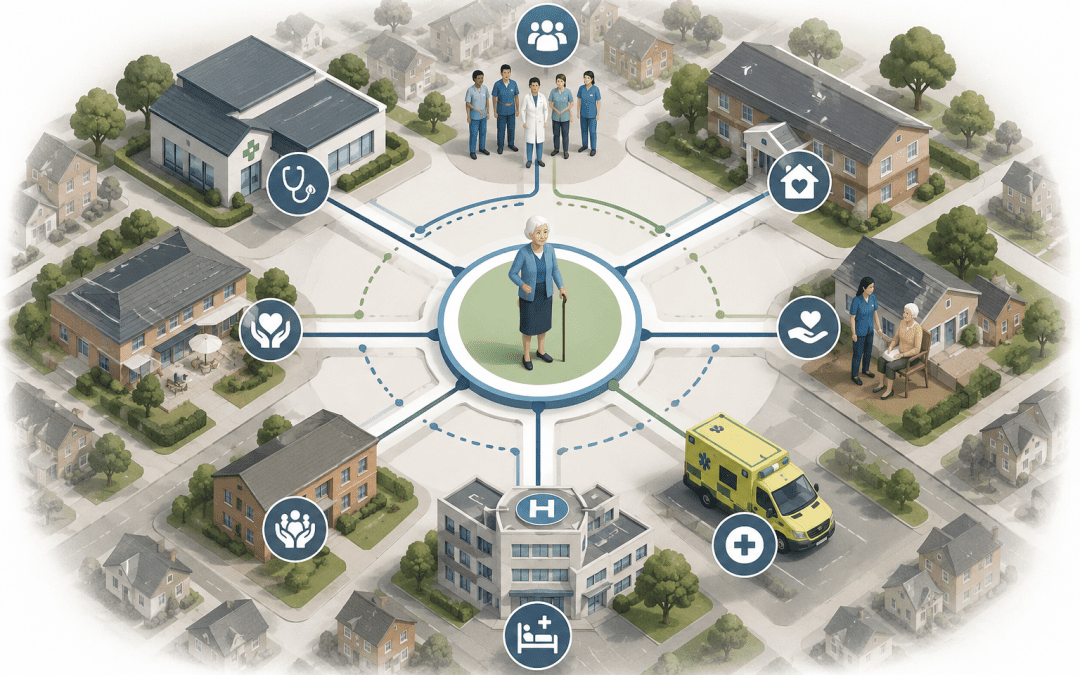
At neighbourhood scale, this creates the conditions for a PCN-aligned Frailty Hub: a different way of organising neighbourhood teams around the individual, bringing continuity, coordination, and CGA together across services and settings.
PCN footprints are not always geographically tidy, particularly within urban systems, and some argue this can complicate neighbourhood service alignment. However, for people living with frailty, continuity and coordinated care around registered populations may matter more than perfectly optimised geographic efficiency.
Co-location and shared neighbourhood estates
Neighbourhood systems should therefore prioritise shared neighbourhood estates wherever possible, particularly across general practice, community services, social care, mental health, and voluntary sector partners.
How integrated neighbourhood teams deliver coordinated, continuous CGA
A PCN-aligned Integrated Neighbourhood Team (INT) delivers it.
The INT is a multidisciplinary, multi-provider workforce that includes community health services, domiciliary and care home providers, the voluntary sector, Older People’s Mental Health (OPMH) services, palliative and end-of-life care services, and acute frailty and specialist teams.
Aligned to a shared neighbourhood footprint, the Hub and INT build the relationships, trust, continuity, and shared understanding needed for teams to function as a coordinated workforce around people living with frailty.
This enables:
• A workforce with the skills to manage complexity in the community
• Shared responsibility rather than repeated handoffs and rejected referrals
• Continuity across hospital admission, discharge, recovery, and deterioration
• More care delivered at home and in familiar settings
A locality-wide acute frailty response at home
However, some episodes of deterioration require a higher level of assessment and treatment than neighbourhood teams can safely provide.
This creates the need for a centralised, locality-wide acute frailty response at home, providing early clinical assessment when deterioration is identified, focusing on diagnosing and treating the underlying cause before crisis escalates.
It also delivers high-acuity care in the community, including same-day diagnostics, intravenous therapies, daily multidisciplinary review, and 24/7 clinical advice. Closely aligned with Same Day Emergency Care (SDEC), it enables rapid access to specialist support without unnecessary hospital attendance.
Once stabilised, care transitions back to the PCN Hub and INT, preserving continuity, coordination, and CGA throughout recovery and rehabilitation.
Building the workforce for neighbourhood frailty care
It requires significant expansion of the Band 7 and Band 8a workforce. These practitioners coordinate care, respond to deterioration, support proactive management, and provide continuity over time, ensuring care evolves rather than repeatedly resetting.
Consultant geriatricians are central to this model. Operating as a networked resource aligned to PCNs across community and acute settings, they support complex decision-making while helping develop the wider neighbourhood workforce through supervision, mentorship, and shared learning.
Their role is not simply to deliver specialist care, but to distribute expertise across the system so more frailty care can be delivered safely, proactively, and continuously within neighbourhood teams.
Alignment with NHS neighbourhood health policy
However, many front-running localities are already moving in this direction, reflecting the wider shift towards neighbourhood-based care that is increasingly embedded across major NHS policy frameworks (1-5), particularly the NHS Ten Year Plan, the Neighbourhood Health Framework, and the NHS England Best Practice Guide for NHS Frailty Pathways.
Across these frameworks, frailty is consistently positioned as a priority population requiring proactive, coordinated, neighbourhood-based care organised around continuity, multidisciplinary working, and Comprehensive Geriatric Assessment.
National guidance increasingly emphasises:
• Active neighbourhood frailty case lists and proactive frailty identification
• Integrated Neighbourhood Teams operating across organisational boundaries
• Shared responsibility for multidisciplinary frailty management
• Single points of access
• Integrated pathways spanning Urgent Community Response (UCR), virtual wards, hospital at home, SDEC, and discharge services
• Shared digital records and shared, editable CGA across providers
• Home-based assessment, proactive care, and continuity following crisis
• Expansion of community-based frailty capability and Band 7/Band 8a workforce capacity
• Consultant geriatricians operating across community and acute settings to distribute specialist frailty expertise
• Greater alignment of workforce, infrastructure, and resources around neighbourhood delivery
In terms of neighbourhood geography, the NHS Ten Year Plan identifies frailty as a national priority area, places community-first integrated care at the centre of neighbourhood delivery, and states that “in many areas, the existing primary care network (PCN) footprint is well set up as a springboard for this type of working.”
In terms of coordination, the Neighbourhood Health Framework establishes frailty as a priority cohort for Integrated Neighbourhood Teams and states that services should be coordinated “around a person’s needs, rather than organisational convenience.”
The NHS England Best Practice Guide for NHS Frailty Pathways further reinforces the importance of neighbourhood multidisciplinary teams, active frailty case lists, shared care records, integrated urgent frailty pathways, continuity across settings, and coordinated community-based frailty care.
PCN Hubs and Integrated Neighbourhood Teams provide one operational structure through which these principles can be delivered at neighbourhood scale.
They represent the convergence of the evidence base, current national policy, and the neighbourhood infrastructure the NHS already has in place.
Where this series goes next
This includes the systems required to enable identification, prioritisation, intervention, and monitoring through shared records, shared CGA, decision support, and population insight.
Without digital infrastructure, continuity fragments, coordination is lost, and CGA collapses back into isolated assessments.
References
- DHSC and NHS England (2026) Neighbourhood Health Framework.
- HM Government (2025) 10 Year Health Plan for England: Fit for the Future.
- NHS England (2026) Medium Term Planning Framework 2026–27 to 2028–29.
- NHS England (2026) NHS Strategic Commissioning Framework.
- NHS England (2026) Best Practice Guide for NHS Frailty Pathways