Over the previous articles in this series, we have been building a population health management approach to frailty.
In Part 1, we described four core capabilities: identification, prioritisation, intervention, and monitoring.
Since then, we have explored each in turn.
In Parts 2, 3, and 4, we explored how people living with frailty can be identified earlier and how those at greatest risk can be prioritised.
In Part 5, we explored the strongest evidence-based interventions for improving outcomes in moderate and severe frailty: continuity, coordination, and Comprehensive Geriatric Assessment (CGA).
In Part 6, we explored how neighbourhood teams could organise themselves to deliver those interventions through PCN-aligned Frailty Hubs, INTs, locality-wide urgent frailty response, and distributed geriatric expertise.
On paper, the model works.
The workforce largely exists.
The evidence base exists.
The policy direction is right.
But in reality, the model will fail.
Bringing teams together is necessary.
But it is not enough.
Two problems remain.
The first is fragmented information.
Identification, prioritisation, continuity, coordination, CGA, and monitoring all depend on teams being able to see the same problems, priorities, and plan.
The second is complexity.
Frailty is complex and relies on clinicians remembering an extraordinary number of things for every patient, every time.
At some point, complexity exceeds what human beings can reliably hold in their heads.
Together, these two problems undermine every stage of population health management for frailty.
Both expose the same uncomfortable truth.
Without digital infrastructure, population health management for frailty fails.
Problem 1: Fragmented records undermine population health management
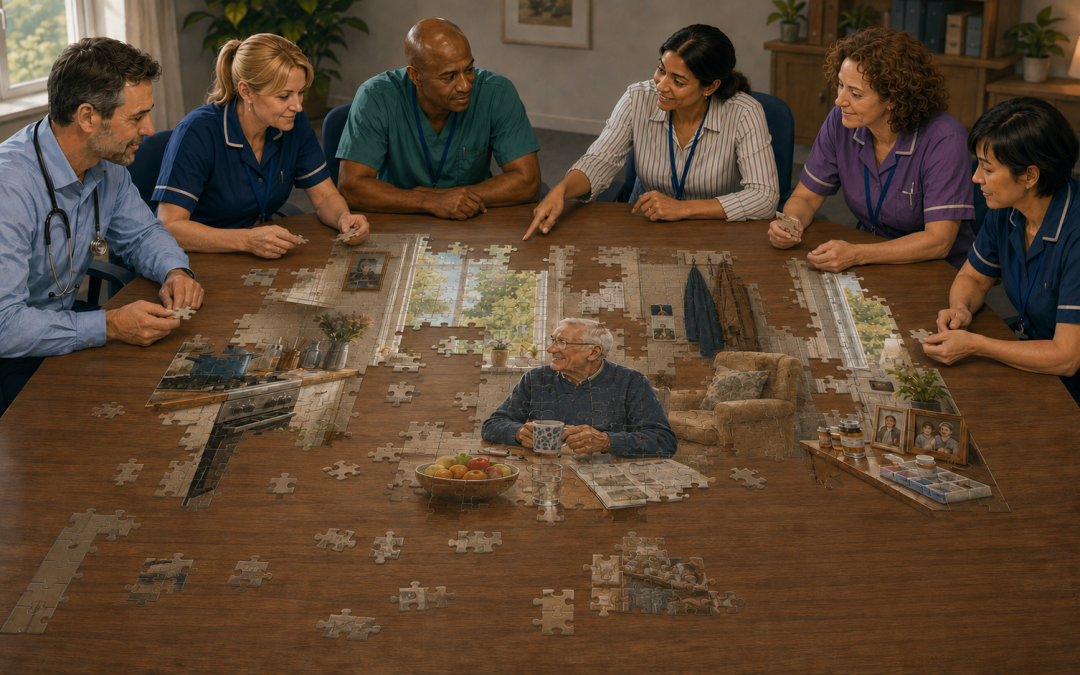
But bringing teams together does not automatically create shared understanding.
Shared understanding depends on teams being able to see the same information.
Imagine the neighbourhood model from Part 6 operating in practice.
The teams are in place.
Relationships are strong.
But the GP holds one record.
Community teams hold another.
Social care holds another.
The urgent frailty service holds another.
The workforce may be organised around the individual.
But information remains fragmented across multiple records, systems, and organisations.
The consequences extend across every stage of population health management for frailty.
Identification becomes fragmented because recognition of frailty in one organisation is not automatically shared with others.
Prioritisation becomes harder because signals of deterioration are spread across multiple records, systems, and organisations.
Continuity weakens because knowledge is repeatedly lost, rediscovered, and recreated rather than carried forward as a shared story.
Coordination becomes dependent on phone calls, emails, meetings, referrals, and handovers as teams attempt to bridge gaps between disconnected records.
CGA fragments because each team contributes to its own assessment rather than building a shared and evolving understanding of the individual.
The system spends enormous effort finding, moving, and reconciling information because it cannot easily share understanding.
Fragmented records do not simply create administrative inconvenience.
They undermine the entire population health management approach to frailty.
Problem 2: Frailty is too complex to manage from memory alone
Even if every professional could access the same information, another challenge would remain.
Frailty is complex.
The model we have described throughout this series depends on neighbourhood teams remembering an extraordinary number of things for every patient, every time.
Consider what we are asking them to do:
- They must remember to identify people living with frailty across a population.
- They must remember who is most at risk of deterioration and prioritise them for review.
- They must remember to provide continuity, coordinate care across teams, and deliver Comprehensive Geriatric Assessment.
- As part of the CGA, they must remember to consider personal goals, advance care planning, long-term conditions, medications, interactions, social circumstances, carer support, mood, cognition, mobility, falls, activities of daily living, nutrition, continence, skin integrity, vision, hearing, and changing patterns of deterioration.
- They must remember to develop a care and support plan, share it with the individual, and communicate it across multiple providers.
And they must remember to do all of this for every patient, every time.
That is not realistic.
At some point, complexity exceeds what human beings can reliably hold in their heads.
Error is inevitable.
Experience helps.
Specialist expertise helps.
Structured assessments reduce the burden on memory.
But they do not remove it.
This is one reason why even specialist frailty services cannot eliminate variation entirely.
Now scale this complexity across neighbourhood teams, where expertise is broader and roles are more diverse.
The challenge becomes even greater.
The aviation industry recognised the challenge of complexity long ago.
A pilot does not fly an aircraft from memory alone.
Expertise remains essential.
But expertise is supported by structured processes, shared information, checklists, and decision support designed to reduce the chance that important steps are missed.
Healthcare is no different.
When complexity is high, memory is not enough.
Summary: The missing foundation
This blog has exposed two fundamental constraints: fragmented information and human cognitive limits.
Digital infrastructure is designed to address both.
It can bring information together into a shared understanding across neighbourhood teams.
It can also reduce reliance on memory by helping clinicians identify frailty, recognise risk, and systematically consider the factors that matter when caring for people living with frailty.
Digital infrastructure is therefore not an optional add-on to neighbourhood frailty care.
It is one of the foundations on which population health management for frailty depends.
Where this series goes next
We will explore how digital infrastructure can overcome these challenges and use examples from THS software to illustrate what this looks like in practice.
We will examine how digital can support systematic frailty identification, detect high-risk signals for prioritisation, and bring information together into a shared understanding across neighbourhood teams.
We will then explore how digital can reduce reliance on memory and support clinicians in managing the complexity of frailty through structured assessment, shared information, and decision support.